That golf cart in the garage and the riding mower in the shed are usually covered exactly as much as homeowners think — which is to say, sometimes, with caveats, and never quite all the way. The gap between what families assume and what their policies actually say has produced some genuinely unpleasant surprises: a golf cart accident on a neighbor’s property, a UTV rollover on a trail, a lawn tractor that caught fire in the driveway. Here’s the honest map of what’s covered, where coverage stops, and how to fill the gaps for less than you’d expect.
What’s Covered by Your Homeowners Policy (and Where It Stops)
Standard homeowners policies extend liability and property coverage to certain motorized vehicles under specific conditions. The operative limitation, which appears in some form in virtually every HO-3 policy, is that the vehicle must be used exclusively on the insured premises — your property — to receive homeowners liability protection.
A riding lawn mower used only in your own yard? Likely covered for property damage under your home policy’s personal property provisions, and likely covered for liability if it injures someone on your property. The moment it crosses onto a neighbor’s lawn, a sidewalk, or a public road, the homeowners liability protection evaporates in most policy forms.
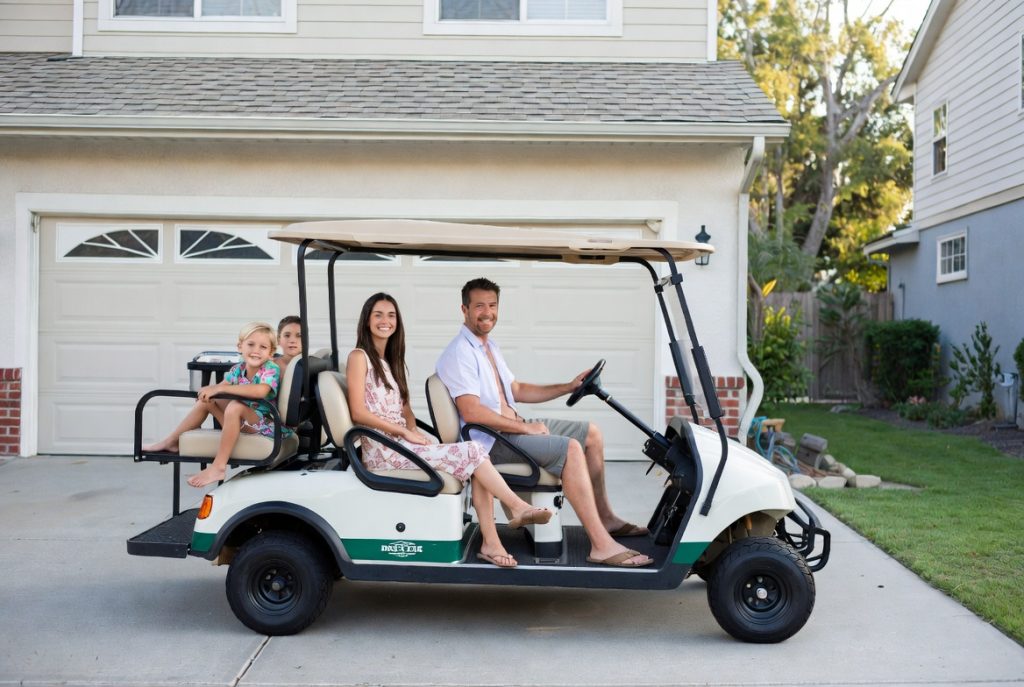
Golf carts on a golf course are an interesting edge case: many standard policies explicitly exclude motor vehicles designed for use off public roads, which is the category golf carts typically fall into. The exclusion exists regardless of where the vehicle is used. If you have a golf cart and you’ve never specifically asked your agent whether it’s covered, assume it isn’t until confirmed otherwise.
ATVs and UTVs (side-by-sides) are excluded by almost every standard homeowners policy. The exclusion language is typically explicit: “motorized vehicles designed for off-road use.” This means that an ATV sitting in your garage is covered as personal property up to your homeowners policy’s personal property sublimits — typically a few thousand dollars for a single item — but any liability arising from its operation, on your property or elsewhere, is not covered.
When You Need a Separate Policy
The threshold is simpler than most people expect: if the vehicle has an engine and is operated by a person (as opposed to being pushed or pulled), and it can cause meaningful injury to people or property, it needs its own liability coverage. The homeowners policy’s premises-only, low-limit structure isn’t designed to carry that weight.
Standalone policies for recreational vehicles and off-road equipment are widely available and surprisingly affordable:
- ATV/UTV endorsements or standalone policies: $50 to $300 per year for a basic policy with $25,000–$100,000 in liability. Comprehensive and collision for the vehicle itself adds to that depending on the vehicle’s value.
- Golf cart policies: $75 to $200 per year for a cart used on a course or within a golf community. Street-legal cart policies (see below) cost more, typically $200–$400 annually.
- Riding lawn tractor endorsements: Some carriers offer a farm equipment or recreational vehicle endorsement that covers riding mowers for a nominal annual premium — often under $50. This is worth asking about if your mower’s replacement value exceeds $2,000.
Off-Road vs. Street-Legal — The Line That Matters
Many communities, particularly in retirement areas and golf cart communities in states like Florida, Georgia, Arizona, and South Carolina, have street-legal golf carts operating on public roads. Once a cart goes on a public road — even a low-speed local road — it crosses from homeowners territory into auto insurance territory entirely. Your auto policy almost certainly excludes it. Your homeowners policy excludes it on a public road. The coverage gap at that point is complete.
Street-legal carts require a separate auto-style insurance policy in most states. Several specialty carriers write these policies specifically; your regular auto or home carrier may refer you out or may offer a rider. The key coverages to carry on a street-legal cart are liability (minimum $50,000/$100,000 for an on-road vehicle) and medical payments. Comprehensive and collision matter if the cart’s value warrants it.
State laws on street-legal carts vary significantly. Florida allows Low-Speed Vehicles (LSVs) on roads with speed limits up to 35 mph; California has similar provisions; other states restrict carts to cart paths and private property only. If you’re operating a cart on a public road in any state, confirm the registration requirement and minimum insurance requirement before your next ride.
A Simple Four-Question Audit
Run through these four questions for each motorized vehicle in your household that isn’t registered as a standard automobile:
- Does it ever leave my property? If yes, your homeowners policy’s liability protection is limited or absent.
- Does it ever go on a public road? If yes, you need auto-style insurance, full stop.
- What is its replacement cost? If the answer is over $2,000, a standalone property policy or endorsement is worth the premium.
- Could it realistically injure someone? If yes — and the honest answer for almost any engine-powered vehicle is yes — standalone liability coverage is the minimum responsible response.
What to do this week: Make a list of every motorized vehicle in your household that isn’t titled as a car or truck. Then call your agent and read that list to them. Ask specifically: “Is each of these covered by my existing policies, and if so, under what conditions?” The conversation will take 15 minutes and will almost certainly surface at least one coverage gap worth closing.
Ready to put this to work? Pull your current declarations page and compare it against these benchmarks — or run a fresh quote to see where the market has moved since your last renewal.
Last modified: February 23, 2026
About the Author: Alex Morgan