
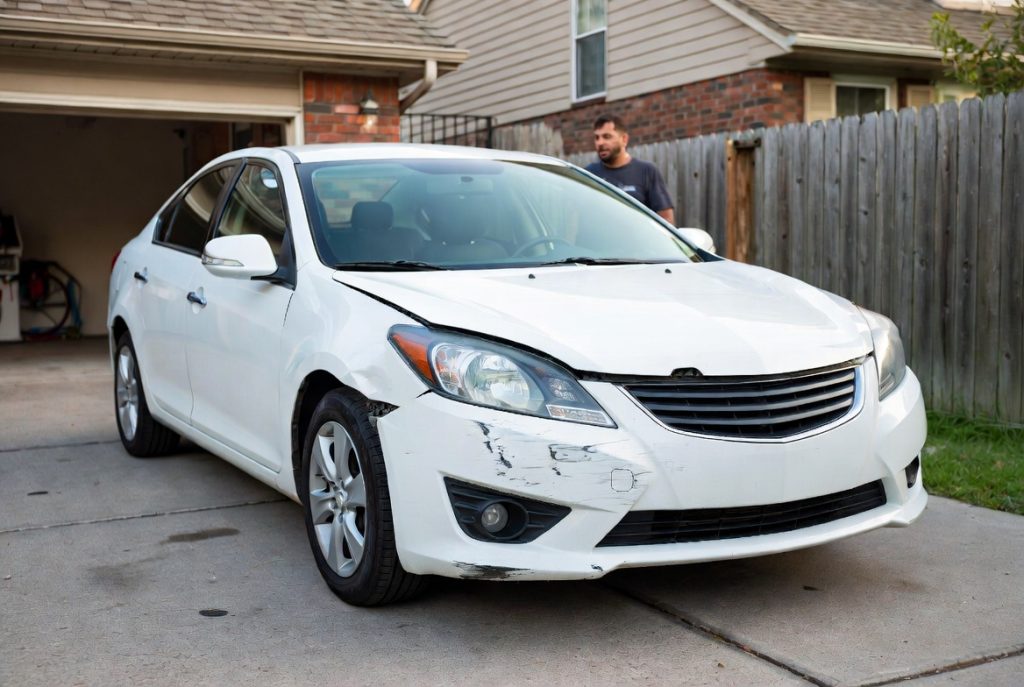
Hitting your own mailbox is funny in a sitcom and slightly less funny on a claims report. The question worth answering before you reach for your phone isn’t “will insurance cover this?” — it’s “should I file at all?” The answer depends on three numbers most people don’t know off the top of their head.
What “Single-Car” Actually Means on a Policy
A driveway incident — backing into the garage door frame, clipping a pillar, tapping your spouse’s bumper while pulling out — is almost always treated as a single-car, at-fault accident. That distinction matters. When no other vehicle is involved, there’s no third-party property damage claim, no bodily injury claim to another party, and no dispute over fault. The claim goes straight to your own collision coverage, and you pay your deductible.
What doesn’t change: an at-fault flag on your record. Single-car accidents are still classified as at-fault events in most carrier systems, which means they factor into your renewal pricing. The absence of another driver doesn’t soften how the incident is coded.
When the Structure You Hit Is Yours
If your car clips your own garage door, your own fence post, or your own retaining wall, you’re dealing with two separate insurance questions on the same incident.
The auto damage — the scrape or dent on your vehicle — is handled by your auto collision coverage, minus your deductible. The structure damage — the garage door frame, the pillar, the fence — is handled by your homeowners policy, under the dwelling or other structures coverage, minus that deductible. You’re filing two separate claims with (potentially) two separate deductibles, unless your carrier offers a single-deductible bundled feature.
For minor incidents — a $200 scrape on the bumper and a $150 garage door repaint — filing either claim rarely makes financial sense. For more serious structural damage (a caved-in garage door at $1,200–$2,500 installed) paired with significant body damage, the math shifts.
Surcharge Thresholds, Plainly
Carriers set a dollar threshold below which they won’t surcharge your premium for a claim. This number varies by carrier and state, but the range is typically $500–$1,500. A claim that falls below the threshold may still appear in your claims history (visible to other carriers when you shop) but won’t directly increase your premium at renewal.
Above the threshold, an at-fault accident surcharge typically runs 20–40% on your collision premium for three years. On a $1,200 annual collision premium, that’s $240–$480 in added cost per year, or $720–$1,440 over the surcharge period. If the repair costs $1,000 and your deductible is $500, you’d pay $500 out of pocket now and potentially $1,440 over three years — a $1,940 total cost to a $1,000 repair.
The math on minor driveway incidents almost always favors paying out of pocket.
A Decision Flowchart
Step 1: Estimate the total repair cost. Get a quick ballpark from a body shop — most will do a visual estimate for free.
Step 2: Subtract your deductible. That’s your net claim benefit if you file.
Step 3: Compare to your estimated three-year surcharge. Multiply your annual collision premium by your carrier’s at-fault surcharge rate (ask your agent; most will tell you). Multiply by three.
Step 4: If the net claim benefit is less than your three-year surcharge cost, pay out of pocket.
Step 5: If the structure was yours and both damages are minor, strongly consider skipping both claims. A homeowners claim stays in CLUE for seven years and affects future insurability, including your ability to switch carriers.
What to Do This Week
- Look up your collision deductible on your declarations page. If it’s below $1,000, consider whether raising it to $1,000 or $1,500 would lower your premium enough to offset the increased exposure on minor incidents.
- Ask your agent what the at-fault surcharge percentage is at your carrier and how long it stays on your record (most carriers: three years; some: five).
- If you have a minor driveway scrape, get a body shop estimate before you call your carrier. Know the number before you make a decision you can’t undo.
- Check whether your carrier offers accident forgiveness — either as a built-in benefit or an add-on — and whether it applies to single-car incidents.
Ready to put this to work? Pull your declarations page and compare your deductible against the repair estimate before you file — or run a fresh quote to see whether your current carrier’s surcharge structure is competitive.
Last modified: March 26, 2026
About the Author: Alex Morgan