
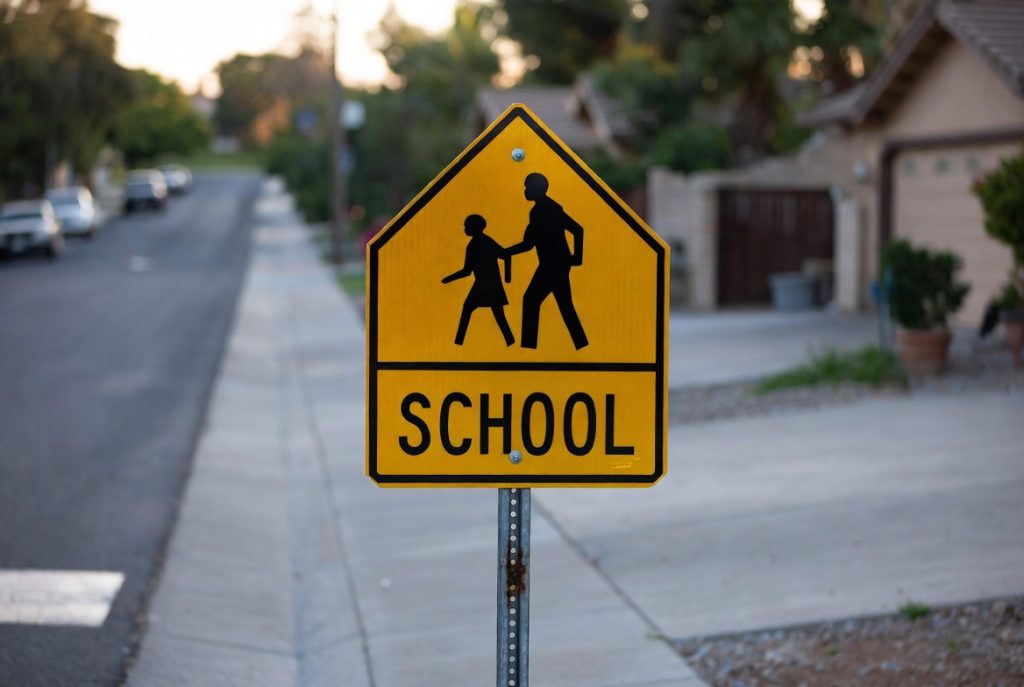
Living near a school is a perk — and an insurance variable most homeowners don’t track. The exposure isn’t dramatic, but it’s specific.
Proximity to a school is a quality-of-life feature that appears in real estate listings. It’s also a context that changes the liability calculus for three or four hours every weekday during the school year. The exposure is narrow and manageable — but it’s real, and the families most exposed to it are often the ones whose kids attend the nearby school and whose driveways are part of the daily foot-traffic pattern.
The Two Categories of School-Zone Liability
School-zone liability for homeowners and drivers tends to cluster into two distinct categories that are often conflated but actually flow through different policies.
The first is vehicle-related liability — incidents involving your car during pickup or drop-off, a backing incident in your driveway during morning rush, or a collision involving a pedestrian in the school zone. These flow through your auto liability coverage. Your homeowner’s policy has no involvement unless the incident originates on your property in a non-vehicle context.
The second is premises liability — a child tripping on your sidewalk during dismissal, a student cutting through your yard and injuring themselves, or a situation where your property itself is part of the school-zone pedestrian path. This flows through your homeowner’s or renter’s policy, specifically the personal liability section. Auto coverage is irrelevant here.
Knowing which bucket a potential incident falls into matters because it determines which policy limit applies, which carrier you call, and what your deductible exposure is. Most families have $300,000 in homeowner’s liability and 100/300 auto liability — but they rarely think of them as the school-zone exposure management tools they happen to be.
Driveway Exits and the Pedestrian Question
Backing out of a driveway during morning school rush is one of the highest-frequency low-speed pedestrian incident scenarios in residential neighborhoods. NHTSA data shows that backover incidents peak between 7:30 and 9:00 a.m. on school days in neighborhoods within a quarter-mile of elementary and middle schools. Children in that window are moving quickly, unpredictably, and often against traffic flow.
The insurance reality: a backover pedestrian incident — even at 5 mph — is a bodily injury liability claim. Your auto policy pays for the injured party’s medical bills and potential pain-and-suffering damages up to your liability limits. If the injured child’s family retains an attorney, a claim against a homeowner backing over a child can reach six figures quickly in medical costs and settlement.
The behavioral change that insurance carriers most consistently credit with reducing these incidents: backing into the driveway in the evening, so that morning departure is forward-facing. It sounds like a minor inconvenience. It is, statistically, one of the most effective single-habit changes for this specific risk profile.
Hosting Carpool: What Changes
If your house is the designated carpool pickup point for four or five neighborhood children, your exposure is slightly different from the home that’s just proximate to a school. When other families’ children are gathering at your property on a regular schedule, your premises liability is the active policy — and your personal liability limit should reflect that exposure.
Standard homeowner’s policies include $100,000 to $300,000 in personal liability coverage. For a household that regularly hosts eight to ten children for carpool assembly, that limit is not excessive — and a personal umbrella policy that extends it to $1 million is typically $150 to $250 per year. The umbrella sits above both your auto and homeowner’s liability limits and activates only after the underlying policy is exhausted.
Carpool agreements — informal documents that parents exchange to clarify expectations, driving assignments, and liability acknowledgment — are common in school communities and worth having. They’re not insurance contracts and don’t bind anyone legally in the way a formal waiver might, but they create a shared understanding of expectations and can be useful context in a dispute. Ask your child’s school whether they have a template.
A Six-Week Behavior Reset
The first six weeks of the school year are when school-zone incidents spike most sharply. Routines aren’t yet established, crossing guard assignments are new, and children are testing the limits of the pickup area. It’s also when families living near the school are recalibrating their own morning patterns after summer.
A deliberate six-week behavior reset at the start of each school year has a practical risk-reduction effect. The reset looks like this:
- Back into your driveway the night before, every evening, so morning departures are forward-facing
- Add two minutes to your departure buffer to eliminate the rushed backing scenario
- Walk the pedestrian path between your property and the school once — understanding where children cut through or gather helps you anticipate their movement
- Review your auto liability limits and confirm your homeowner’s personal liability coverage before the school year begins
None of this is dramatic. All of it is specific to the school-zone context that most insurance checklists don’t address because it doesn’t apply to most of the country — just to the families for whom it applies every single school day.
What to Do This Week
Check your homeowner’s personal liability limit and your auto liability limit on your declarations page. If you host carpool regularly and your homeowner’s liability is under $300,000, price an umbrella policy — it’s usually a single phone call and less than $20 per month. And start backing into the driveway tonight.
Ready to put this to work? Pull your current declarations page and compare it against these benchmarks — or run a fresh quote to see where the market has moved since your last renewal.
Last modified: March 23, 2026
About the Author: Alex Morgan