
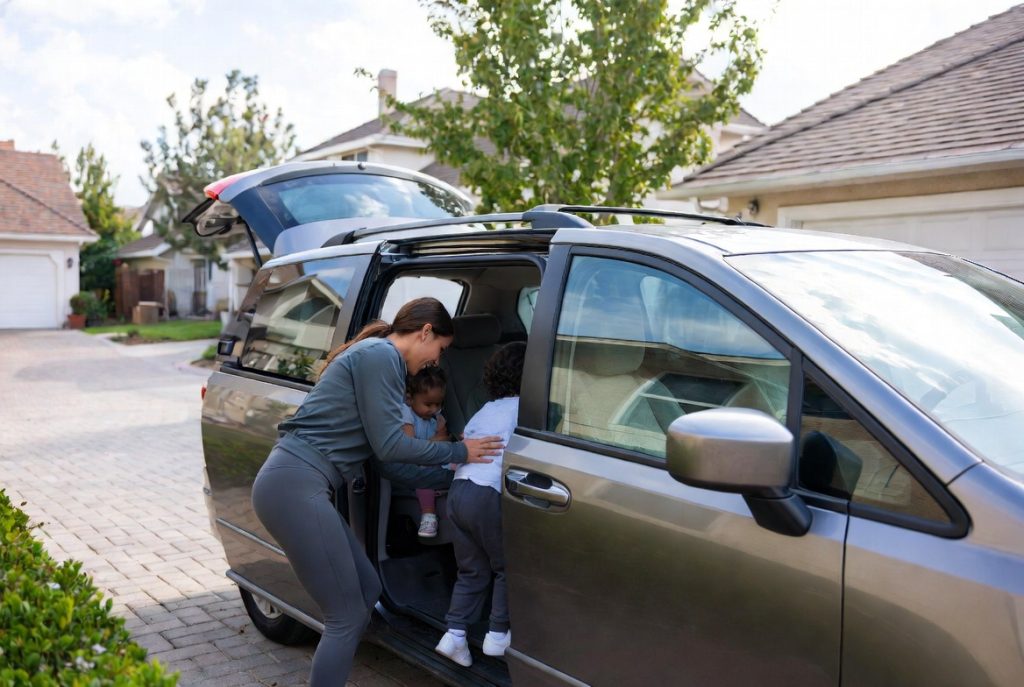
Most policies handle a one-off babysitter drive without drama. A regular caregiver who drives your kids twice a week is a different question — and one that’s better resolved before, not after. The coverage doesn’t disappear, but the policy language that applies shifts in ways that matter, particularly when a claim involves your children as passengers.
Here’s what you actually need to know about permissive use, where the rules get more complicated, and a simple test to decide whether your caregiver should be on your policy.
Permissive Use, in Plain English
Permissive use means your policy covers someone who drives your vehicle with your permission. You don’t need to name them on the policy. You don’t need to pre-authorize every specific trip. If you gave someone general permission to use your car — or if it’s reasonable to assume you would have — your coverage applies when they’re behind the wheel.
The protection is real. Your liability coverage, comprehensive, and collision all follow the vehicle, not just the listed drivers. If your babysitter drives your Pilot to pick up your kids and rear-ends someone at a school crosswalk, your policy is primary. Your deductible applies. Your carrier pays the claim up to your limits.
The catch is that permissive use doesn’t override every policy provision. Some carriers include sub-limits for unlisted permissive drivers — most commonly 20–25% of your stated liability limits. If your policy has $300,000 in liability and a permissive use sub-limit, an unlisted driver might only carry $75,000 of that. For a school parking lot fender-bender, that’s probably fine. For a serious injury claim with children in the vehicle, it may not be.
When Occasional Becomes Regular
Most carriers define “occasional” use without putting a firm number on it. In practice, the threshold that tends to shift how underwriters and adjusters view the situation is roughly 2–3 times per week on a consistent, recurring basis. At that frequency, the driver is no longer truly occasional — they’re a regular operator of the vehicle.
The problem isn’t that coverage suddenly disappears. The problem is that if a claim occurs and the carrier’s investigation reveals a regular unlisted driver, they have grounds to argue that the driver should have been disclosed. Non-disclosure of a regular driver is a material misrepresentation issue. It doesn’t mean you lose the claim, but it creates a dispute you don’t want to be in while your family is dealing with an accident.
Some carriers explicitly define household members and require that any licensed driver residing in or regularly operating from the household be listed. If your caregiver parks at your house, stores a car seat in your vehicle permanently, or uses the car as a consistent part of their employment duties, you’re in regular-driver territory.
Should They Be on the Policy?
Adding a named driver to your policy has a cost. For a caregiver with a clean driving record in their 30s or 40s, that cost is typically modest — often $50–$150 per year. For a caregiver with a recent at-fault accident or a younger age profile, it can be more. But compare that cost against the alternative: a coverage dispute during a claim that involves your children as passengers.
Adding them also resolves the permissive use sub-limit issue entirely. A named driver carries the full limits of your policy. That’s meaningful protection if the caregiver is regularly transporting your family.
One question to ask your carrier: can the caregiver be listed as an “excluded” driver on your policy if they have a poor driving record that would substantially raise your premium? Exclusion lists them explicitly, removes coverage for them, but also formally resolves the ambiguity about whether they’re an undisclosed regular driver. It’s a cleaner paper trail than simply hoping coverage applies.
A Simple Two-Question Test
Before your next renewal, ask yourself two questions about any caregiver who drives your vehicle:
- Does this person drive my vehicle more than once per week on a regular schedule? If yes, they should be disclosed to your carrier.
- Do my liability limits include a permissive use sub-limit? Pull your declarations page or call your agent. If there’s a sub-limit and the caregiver drives regularly, add them as a named driver.
If both answers are no, your current arrangement is almost certainly fine. If either answer is yes, a five-minute conversation with your agent resolves the issue before it becomes a claims conversation.
What to Do This Week
Pull your declarations page and look for any language about permissive user sub-limits. If you have a caregiver who drives your vehicle on a regular schedule, call your carrier and describe the arrangement plainly. Ask what you need to do to ensure full coverage applies. The answer takes five minutes to get and months to wish you had gotten earlier.
Ready to put this to work? Pull your current declarations page and compare it against these benchmarks — or run a fresh quote to see where the market has moved since your last renewal.
Last modified: April 30, 2026
About the Author: Alex Morgan