
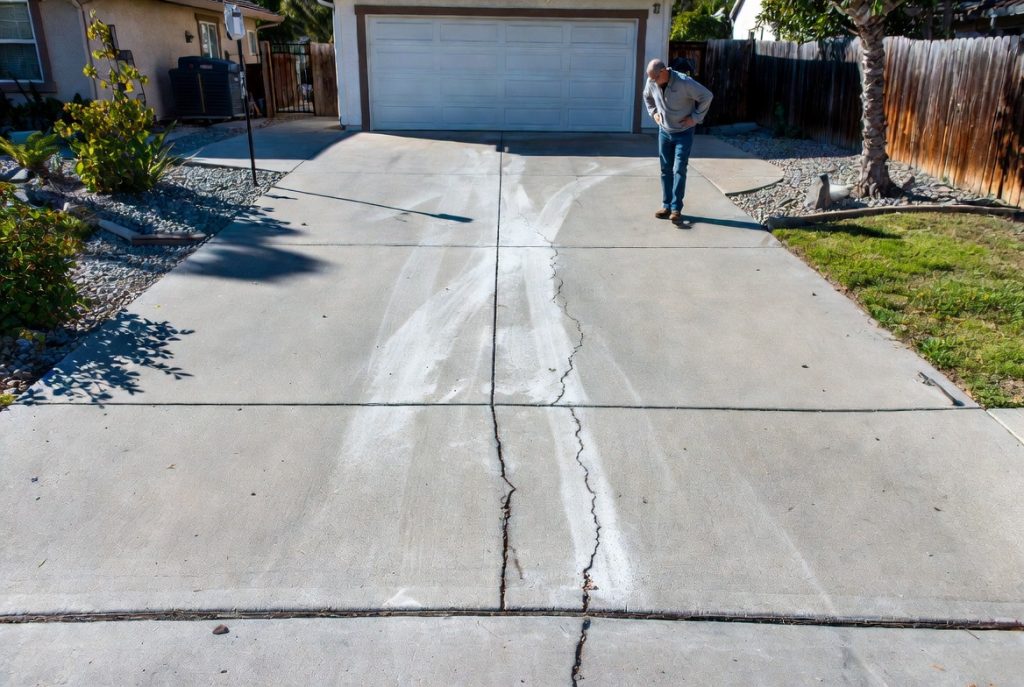
When a car hits a driveway — yours, theirs, the neighbor’s — the question of who pays for the concrete is more complicated than the question of who pays for the car. Vehicle damage has a clear owner and a clear insurance line. Structural damage to real property involves homeowner’s policies, liability triggers, deductible math, and a subrogation question that surprises most families the first time they deal with it.
Here’s how the coverage actually sorts out across the most common scenarios.
The Car vs. the Structure — Which Policy Pays
The starting principle is that auto insurance covers automobiles, and property insurance covers structures. But each policy has a liability component that extends to damage you cause to other people’s property. The interaction between those two systems is where most of the confusion lives.
Your homeowner’s policy typically includes:
- Dwelling coverage (Coverage A): Covers your home’s attached structure — attached garage, attached approach.
- Other structures coverage (Coverage B): Usually 10% of your dwelling limit, covers detached garages, fences, standalone driveways, and similar structures.
- Liability coverage (Coverage E): Covers you for accidental damage you cause to other people’s property — including their driveway.
Your auto policy’s liability component covers bodily injury and property damage you cause to others while operating a vehicle. Property damage to someone else’s structure is a legitimate auto liability claim.
Your Driveway, Your Fault, Your Car
If you back into your own concrete apron or crack your own driveway pad, you have two potential coverage routes — both of which have complications.
Filing a homeowner’s claim on your own driveway means satisfying your homeowner’s deductible (typically $1,000–$2,500) and introducing a claim to your property record. Driveway damage repair for a concrete pad usually runs $800–$3,000 depending on scope. If the damage is at or below your deductible, there’s no claim to file — it’s an out-of-pocket repair. If it’s just above your deductible, the math rarely favors a claim; the saved cost is modest and the claims record carries for three to five years.
Filing an auto liability claim on your own property doesn’t work. Liability coverage is for damage to others. You can’t be both the at-fault party and the damaged party on an auto liability claim.
The practical answer here is usually: pay out of pocket for modest damage, file the homeowner’s claim only for significant structural damage (say, $5,000+), and take the hit from a deductible perspective.
A Visitor’s Car Damages Your Driveway
If someone else’s vehicle damages your driveway — a delivery truck jumps the curb, a neighbor backs into the concrete border while turning around — the at-fault driver’s auto liability coverage should pay for your driveway repair.
File the claim against their carrier under property damage liability. Get a repair estimate first, then provide it to their carrier as part of the claim. If their carrier disputes the amount, your homeowner’s liability claim record can serve as a backup — though filing a homeowner’s claim on damage caused by someone else’s vehicle just to collect quickly, and then subrogating, is worth discussing with your agent before you do it.
Subrogation means your carrier pays you and then pursues reimbursement from the at-fault party’s carrier. It’s a legitimate option if the at-fault driver is uninsured or unresponsive. The tradeoff: your carrier pays, your deductible may apply temporarily, and the process takes time.
Your Car Damages a Neighbor’s Driveway
This is the most straightforward scenario from a coverage standpoint. Your auto liability coverage applies when your vehicle causes property damage to someone else’s property — including their driveway, fence, mailbox, or landscaping.
Standard personal auto liability covers property damage typically between $25,000 and $100,000 depending on your selected limits. A driveway repair claim against your auto liability does not require a deductible — liability coverage has no deductible. Your premium may increase at renewal depending on your carrier’s surcharge schedule, though property damage claims to small residential structures are often treated less severely than bodily injury claims.
The calculus to work through: if the damage is modest — say $600 to a neighbor’s cracked apron — consider paying out of pocket rather than filing a liability claim. A claim record follows you for three to five years. A $600 check to your neighbor does not.
What to Do This Week
Find the “other structures” coverage limit on your homeowner’s declarations page. It’s typically listed as Coverage B. Make sure it’s at least $20,000 — enough to cover a full concrete driveway replacement in most markets. If it’s set at the default 10% of a $150,000 dwelling limit, that’s $15,000, which may be fine — but in areas where concrete work runs high, it’s worth confirming.
Ready to put this to work? Pull your current declarations page and compare it against these benchmarks — or run a fresh quote to see where the market has moved since your last renewal.
Last modified: May 9, 2026
About the Author: Alex Morgan