Deer claims are the most predictable comprehensive claim category in America — they cluster by month, by hour, and by zip code. Knowing the pattern is more than half the prevention. If you can anticipate when and where these collisions happen, you can drive differently during those windows, and if you can’t avoid one, you can handle the aftermath without leaving money on the table.
So let’s go through this methodically: when the risk peaks, what actually helps behind the wheel, what to do in those first ten minutes, and what a deer claim does — and doesn’t — do to your record.
When Deer Claims Spike (and Why)
The Insurance Institute for Highway Safety tracks roughly 1.5 million deer-vehicle collisions per year in the United States. They don’t distribute evenly across the calendar. About 50% occur in a ten-week window running from mid-October through late November — the peak of white-tailed deer rutting season, when bucks are moving aggressively and erratically during low-light hours.
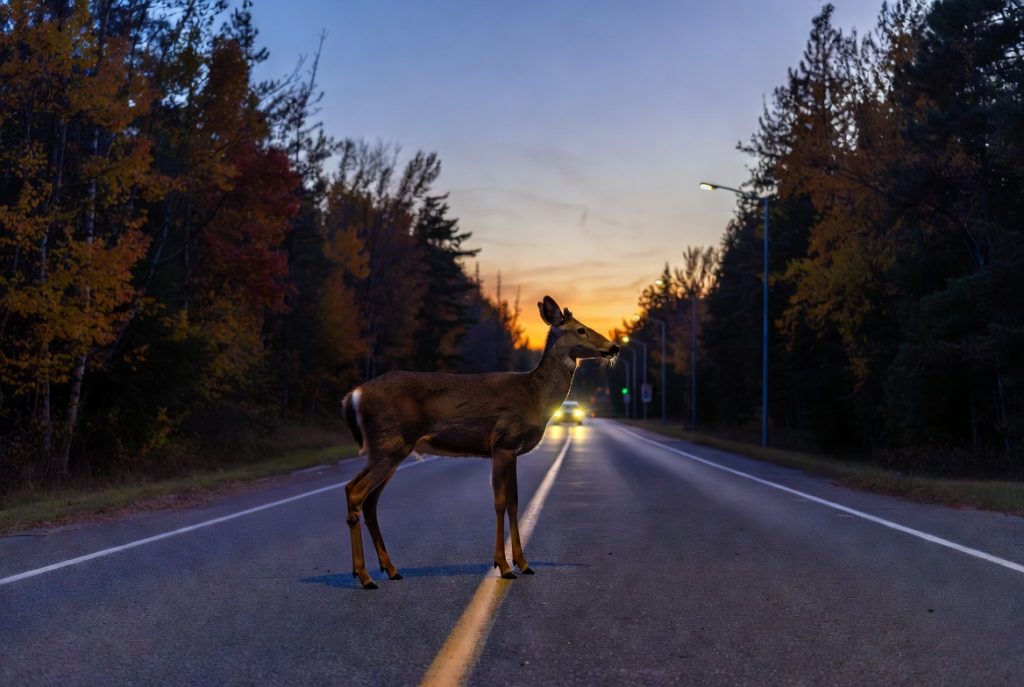
Dusk and dawn account for the overwhelming majority of strikes. Deer are crepuscular — most active in the hour before sunrise and the hour after sunset. From October through December, that window coincides almost exactly with commute traffic. The combination is not subtle: more deer moving, less visibility, more cars on the road.
Geographically, the highest-claim states are Pennsylvania, Michigan, Wisconsin, Iowa, and Texas — but suburban fringe zones in nearly every state have seen deer populations increase as development pushes into habitat edge areas. If your drive to work includes any stretch of road bordering a woodline, field, or creek corridor, the map applies to you.
Driving Habits That Genuinely Help
The standard advice — slow down, use your brights — is true but incomplete. Here’s what actually changes outcomes:
- Scan wide, not just ahead. Deer at road edges disappear in peripheral vision unless you’re actively looking left and right in zones with known habitat.
- Treat the first deer as a warning. Deer rarely travel alone. If one crosses, expect others within 30 seconds. Come to a full stop if you can do so safely.
- Don’t swerve for the deer. More injury accidents result from swerving than from striking the animal. Brake firmly, hold your lane, and brace. A deer collision you control is substantially safer than an overcorrection into oncoming traffic or a ditch.
- High beams where legal and safe. On rural two-lane roads at night, high beams give you an additional 200–300 feet of reaction distance. The deer’s eye-shine reflects well before your low beams would reveal it.
What to Do in the First 10 Minutes After
If a collision happens, the sequence matters:
- Pull safely off the road. A disabled vehicle in the travel lane creates a second accident waiting to happen.
- Turn on your hazards immediately. Even before you assess damage.
- Do not approach the deer. An injured deer is dangerous. If it’s in the road and creating a hazard, call local police — they’ll handle removal.
- Document everything. Photograph the vehicle damage, your location, and the roadway. If the deer is visible, include it in the photos. This documentation matters when you file the claim.
- Call your carrier, not a body shop first. Let the claims process determine where the car goes. Using an unauthorized shop can complicate payment.
One question families ask: do you need a police report? Some states require it for insurance purposes if damage exceeds a threshold — typically $500–$1,000. Even where it’s not required, a report creates a paper trail that removes any ambiguity about what happened.
How a Deer Claim Affects Your Record (and Doesn’t)
This is the part most drivers get wrong. A deer collision is a comprehensive claim — not a collision claim — because the cause is an animal strike, not an at-fault accident. Comprehensive claims are treated fundamentally differently by carriers.
Comprehensive claims almost never trigger a surcharge or rate increase, because they’re classified as not-at-fault and outside the driver’s control. State regulations in most jurisdictions explicitly limit carriers from penalizing drivers for comprehensive events. Your claims-free discount may be evaluated differently depending on your carrier’s specific language, so it’s worth a five-minute call to confirm — but the surcharge that follows an at-fault collision simply doesn’t apply here.
The deductible does apply, however. If your comprehensive deductible is $500 and the damage is $800, you’ll pay the deductible and the carrier covers the rest. If damage is below your deductible, filing a claim accomplishes nothing and creates a claims record. In that case, pay out of pocket and document the incident privately.
What to Do This Week
Confirm your comprehensive deductible — it should be somewhere in the $100–$500 range for most family drivers. If you’ve been carrying a $1,000 comprehensive deductible to save on premium, price the difference at a lower deductible. Given that deer claims average $4,300–$4,700 in vehicle damage, closing that gap is often worth $50–$80 per year in additional premium.
Ready to put this to work? Pull your current declarations page and compare it against these benchmarks — or run a fresh quote to see where the market has moved since your last renewal.
Last modified: April 23, 2026
About the Author: Alex Morgan