
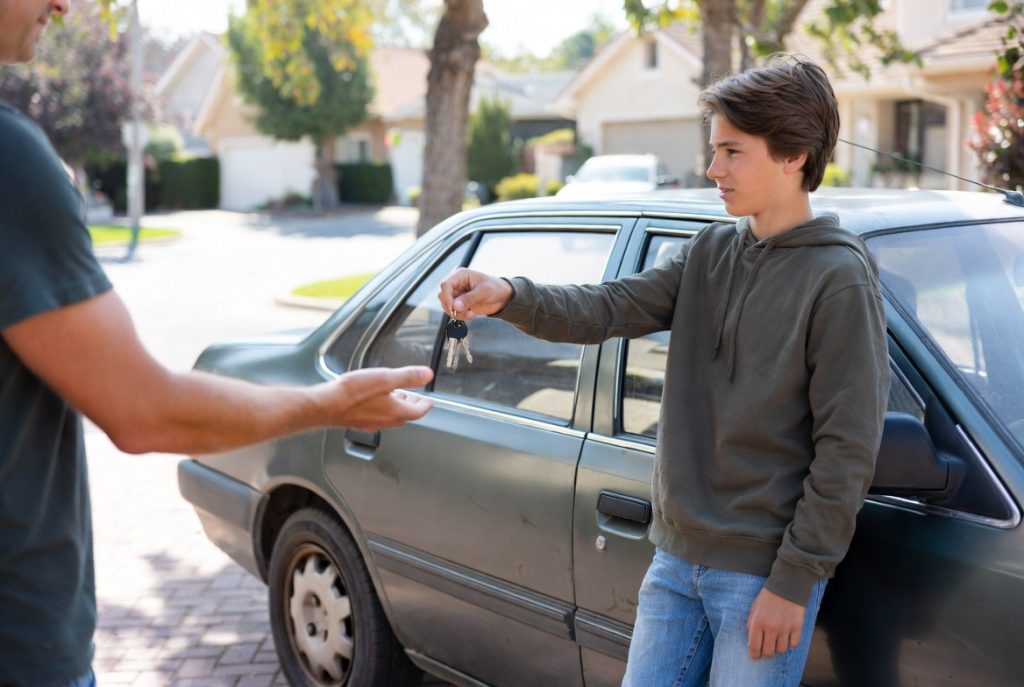
The intuition is rock solid: handing down the old car saves money. You’re not buying a new vehicle, the car is already paid off, and your teen gets wheels without a monthly payment. The receipts, however, tell a more complicated story — especially when insurance enters the calculation. In three specific scenarios, the hand-me-down strategy generates costs that parents didn’t anticipate and wouldn’t have accepted if they’d done the math first.
When the Strategy Works
The hand-me-down is genuinely the right call when the vehicle is worth enough to have some accident buffer, safe enough to protect a new driver adequately, and cheap enough to insure without making the monthly cost feel punitive. Specifically:
A vehicle worth $8,000–$15,000 in good mechanical condition, with modern safety features (airbags, ABS, backup camera at minimum), and with a modest liability-to-collision premium ratio is the sweet spot. You’re getting real-world financial protection if the car is totaled, meaningful safety equipment, and a manageable insurance cost.
The strategy also works when the teen is the primary driver of the handed-down vehicle and the parents retain separate, newer vehicles. Insurance carriers rate teen premiums by the vehicle the teen is primarily assigned to. Assigning the teen to the older, cheaper vehicle rather than the household’s higher-value car is sound financial planning.
Three Scenarios Where It Backfires
Scenario 1: The car is too old to carry full coverage, but too valuable to skip it. If the vehicle’s actual cash value is in the $3,000–$5,000 range, you’re in a mathematical trap. Full coverage (collision plus comprehensive) on a $4,000 vehicle might run $600–$900 per year for a teen driver. Your maximum payout on a total loss is $4,000 minus your deductible — say, $3,000 net. You’re paying roughly 20–30% of the vehicle’s value annually in premium to protect it. But if you skip collision and the car gets totaled in a minor accident, you’re buying another car immediately. Neither option is clean. The hand-me-down worked better at $10,000 or $12,000, where the math supports full coverage.
Scenario 2: The car lacks the safety features that newer vehicles have. Vehicles manufactured before 2012–2014 increasingly lack automatic emergency braking, lane departure warning, and modern airbag arrays. Insurance aside, the safety gap between a 2010 model and a 2020 model is substantial. Carriers reflect this in crash-severity loss data — older vehicles have higher injury claims per collision because of the missing safety equipment. This isn’t a reason to reflexively avoid older vehicles; it’s a reason to be honest about what you’re trading away in safety margin when you go cheap.
Scenario 3: The repair-cost-to-value ratio is already at the tipping point. A 12-year-old vehicle that’s needed two major repairs in the past 18 months is statistically likely to need more. If your teen has an at-fault accident that causes $1,500 in damage to a car worth $3,500, your carrier may total it rather than repair it — and your payout ($3,500 minus deductible) doesn’t buy a replacement vehicle. You’ve funded two years of teen driver insurance on a vehicle that turned into a $2,500 net payout at the worst possible moment.
The “Buy Something Newer for the Teen” Counterargument
It sounds counterintuitive, but buying a 3–5 year old used vehicle for a teen driver rather than handing down a 10–12 year old vehicle sometimes costs less over a three-year horizon. The newer vehicle:
- Has better safety equipment, which may qualify for carrier safety discounts
- Is less likely to need expensive mechanical repairs during the teen’s first years of driving
- Has a higher actual cash value, making comprehensive and collision coverage cost-effective
- Retains enough value that a total-loss payout is meaningful
The math depends heavily on the specific vehicles being compared and your local market. But the instinct that “older is always cheaper” breaks down reliably in the $3,000–$7,000 vehicle range when you factor in insurance cost, maintenance probability, and safety equipment.
A Decision Framework
Step 1: Get the vehicle’s current actual cash value from KBB or NADA. This is the number that caps your payout on a total loss.
Step 2: Get a teen driver insurance quote for the specific vehicle with full coverage. Compare it to the ACV — if the annual premium exceeds 10–15% of ACV, reconsider carrying collision.
Step 3: Assess recent repair history. Two or more major repairs in the past 24 months signals elevated future repair probability.
Step 4: Compare to a 3–5 year old alternative at the bottom of your local used car market. Sometimes the newer option is only $2,000–$3,000 more upfront but saves meaningfully over three years in repair avoidance and insurance efficiency.
What to Do This Week
- Get a teen driver quote on your current hand-me-down candidate before you finalize the decision — the number may change the conversation.
- Check the vehicle’s ACV on KBB and compare it against your collision deductible. If the gap is too small, skip collision.
- Pull the vehicle’s repair history (Carfax or similar) and add up the last 24 months of mechanical costs. Project forward.
- Ask your agent what safety-equipment discounts apply to vehicles with specific features — sometimes a slightly newer vehicle qualifies for discounts that offset its higher base premium.
Ready to put this to work? Get a quote on the actual vehicle before you hand over the keys — or compare your current policy against the market to make sure you’re not overpaying for teen driver coverage.
Last modified: April 14, 2026
About the Author: Alex Morgan