
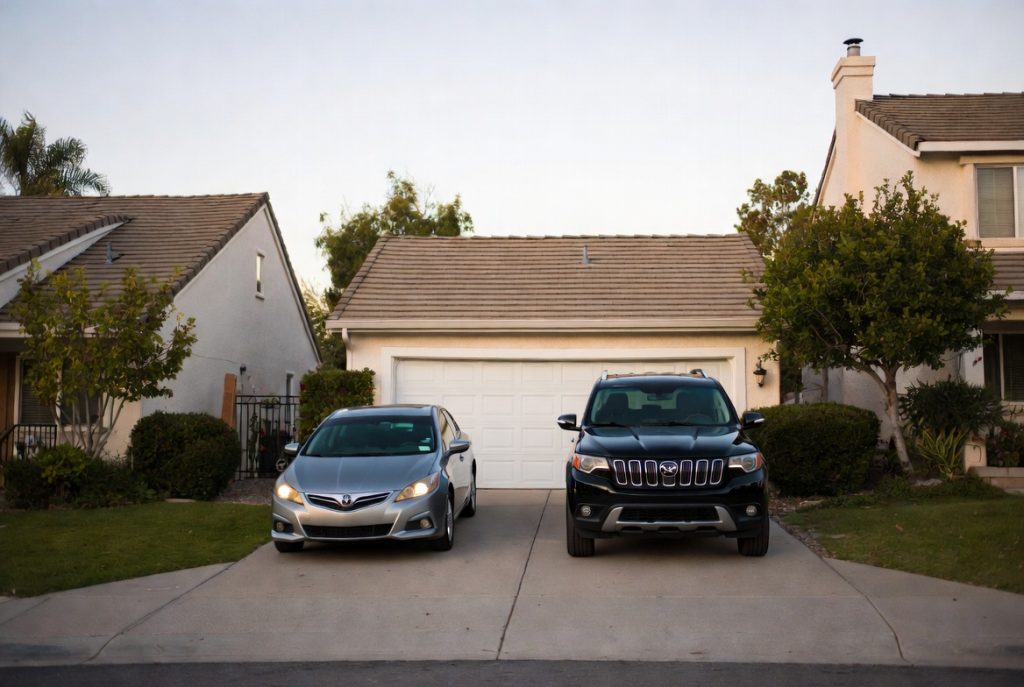
Two cars in a household almost always save money on insurance. Three cars usually do. Once you start adding a fourth vehicle — or a second licensed driver with a complicated record — the discount math gets unpredictable, and the assumptions baked into your current policy may no longer serve your household well. Here’s how to read the numbers and keep the structure working in your favor.
Why the Multi-Car Discount Exists
Carriers offer multi-vehicle discounts for the same reason they offer bundling discounts: administrative efficiency and retention value. One household is one account to manage, one renewal to write, one agent relationship to maintain. The multi-car discount is the carrier’s way of paying you to consolidate your business with them. The typical range is 10–25% off each vehicle’s premium, though the exact percentage varies by carrier and state. What most people don’t realize is that the discount is applied per vehicle, not per policy — meaning each car on your account benefits from the discount, not just the added car.
The Two-Car Sweet Spot
Two-vehicle households consistently get the best discount-to-premium ratio. Both cars benefit from the multi-car discount, the household risk profile is relatively simple to rate, and there’s usually a clean driver-to-vehicle assignment (more on that below). If you’re a two-car household, your primary job is to make sure the assignment is structured correctly and to shop the policy at least every other renewal cycle to ensure the bundled rate remains competitive.
When Adding Car Number Three or Four Reverses the Savings
The discount typically plateaus after two or three vehicles. Adding a fourth car may not meaningfully increase the percentage discount, but it adds a full vehicle’s worth of premium to your base. More importantly, adding a vehicle can trigger a re-rating of all drivers in your household. If you add a vehicle that is newer, more expensive, or higher-risk than your existing fleet, the carrier recalculates your household profile — and the drivers previously assigned to cheaper cars may be reassigned in ways that raise the premium on your lower-cost vehicles.
The real math to run: add up your total household premium before and after adding the third or fourth vehicle. If the premium increase on your existing vehicles exceeds the discount you expected on the new vehicle, you’ve moved into negative territory. This happens most often when the new vehicle is substantially more expensive to insure than the existing fleet, or when a high-risk driver in the household gets assigned to a newer car.
Driver-to-Vehicle Assignment Strategy
Every carrier assigns drivers to vehicles in your household. Even if everyone “drives everything,” the carrier picks a primary driver for each vehicle for rating purposes. The standard rule: assign the highest-risk driver (teen, recent ticket, newer license) to the lowest-value vehicle. Assign the cleanest record to the most valuable or newest vehicle. This isn’t manipulation — it’s accuracy, assuming the assignments reflect reality.
Where it gets complicated: some carriers will “cross-assign” drivers if they determine the paperwork doesn’t match the usage patterns their telematics data suggests. If your teen’s telematics device shows them primarily driving the newer SUV, the carrier may re-rate accordingly at renewal. The assignment needs to reflect actual usage to avoid both a rate surprise and a potential coverage dispute.
The “Ghost Driver” Problem
This is what happens when a licensed driver lives in or regularly uses your household vehicles but isn’t listed on the policy. A college student who came home and drives your car on weekends, an aging parent who occasionally uses your vehicle, a live-in adult child who has their own policy elsewhere — all of these situations create a “ghost driver” exposure. If that driver is in an accident in your vehicle, your carrier may investigate whether they were a regular operator who should have been rated. The result can be a claim denial, a surcharge applied retroactively, or both. List all regular drivers. If you’re uncertain whether someone qualifies, ask your carrier directly.
Annual Audit: A Five-Question Checklist
- Has any driver in the household changed vehicles as their primary car in the last 12 months?
- Has any vehicle been added, sold, or traded in without a corresponding policy update?
- Is every licensed member of the household listed on the policy?
- Are the coverage levels on each vehicle still appropriate to its current value?
- Has the multi-car discount percentage changed since last renewal?
What to Do This Week
Pull your declarations page and verify the driver-to-vehicle assignments match reality. Call your agent and ask for the multi-car discount percentage you’re currently receiving. If you’re adding a vehicle soon, ask the agent to model the full household re-rate before you commit — not just the quote on the new vehicle in isolation.
Ready to put this to work? Pull your current declarations page and compare it against these benchmarks — or run a fresh quote to see where the market has moved since your last renewal.
Last modified: January 17, 2026
About the Author: Alex Morgan