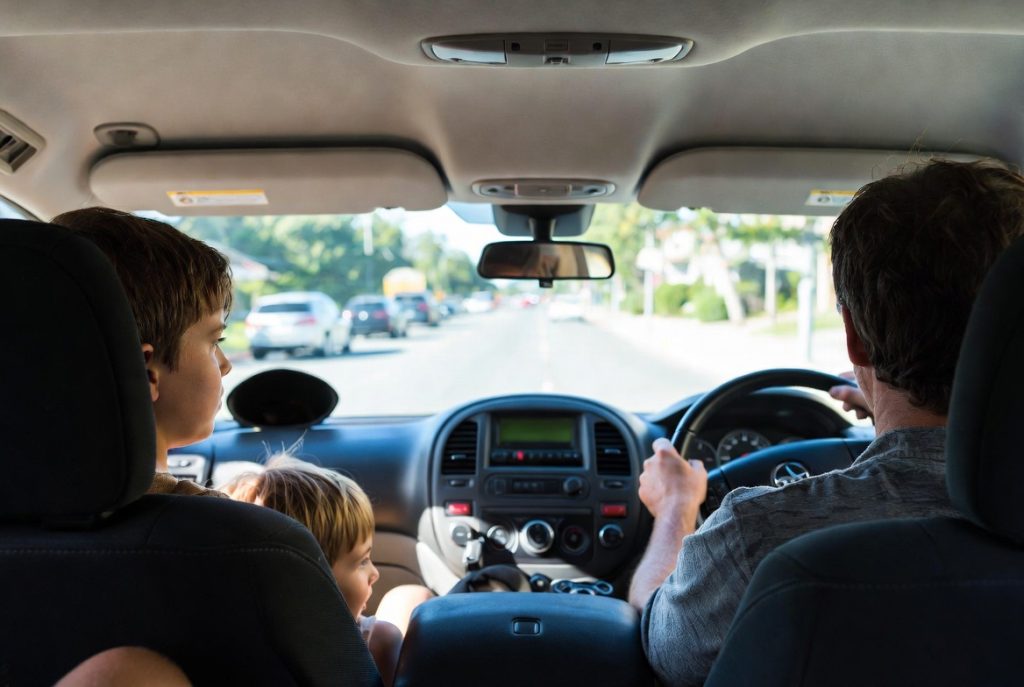
A car with two kids in it is not the same driving environment as a car with one quiet adult passenger. The data is unambiguous, and the strategies that actually work aren’t the ones in the brochure.
Most distracted-driving campaigns are built around the single-driver, single-screen scenario — put the phone down, eyes on the road, done. That advice isn’t wrong. It’s just incomplete for the parent hauling three children, a dog, a lacrosse bag, and somebody’s half-eaten granola bar from Tuesday. Your situation has its own data, and it suggests different interventions.
The Actual Data on Family Vehicles
NHTSA data consistently shows that passengers are a distraction factor — not just phones. Research from Virginia Tech’s Transportation Institute found that having young children as passengers increases crash risk by roughly 12 percent compared to driving alone. When a parent turns to address a backseat dispute, average eyes-off-road time runs 3.4 seconds. At 60 mph, that’s the length of a football field driven blind.
Minivans and three-row SUVs don’t change the physics, but they do change the acoustics and sightlines in ways that make intervention more tempting. The driver can hear the squabble but can’t quite reach anyone, which produces the worst possible response: a slow turn and a distracted arm-wave that takes both eyes off the road and one hand off the wheel.
The secondary layer: family vehicles accumulate more annual miles than single-occupant commuter cars. More miles means more exposure, and distracted driving risk compounds with exposure time.
Three Strategies That Work
Set rules before the wheels turn
Behavioral research on distracted driving shows that pre-trip agreements outperform in-trip corrections by a wide margin. Before you leave the driveway, establish expectations aloud: noise threshold, screen time, bathroom stops. Children who have a clear framework for the trip generate fewer unexpected interruptions. This isn’t parenting advice — it’s risk management.
Use a phone mount and voice commands for everything
Hands-free is not distraction-free, but the data shows it meaningfully reduces physical distraction. A dash-mounted phone in navigation mode reduces the temptation to pick it up by about 60 percent compared to a pocket device. Voice commands for music, calls, and texts keep your eyes forward. Set it before you move — not at the first red light.
Pull over to resolve conflicts
This feels dramatic until you do it twice and your kids realize you mean it. A 90-second stop at a gas station lot to settle a backseat dispute is vastly preferable to a 30-second distracted swerve. It also changes your children’s calculation about whether escalating is worth it.
Three Strategies That Don’t Work (Despite Popular Belief)
Rear-seat screens as a universal solution
Entertainment systems reduce some conflicts, but they introduce a new category: the parent’s instinct to glance back and check what’s playing. If the content is age-appropriate and self-managing, screens help. If you’re actively cueing up the next episode at 70 mph, you’ve traded one distraction for a worse one.
Multitasking at low speeds
Parents frequently treat school-zone and parking-lot speeds as safe windows for quick phone glances or backseat hand-offs. Pedestrian accidents and low-speed lot incidents are disproportionately common precisely in those zones — because everyone else is also distracted and moving unpredictably.
Telling kids to “just be quiet”
Reactive commands from the driver require the driver to engage emotionally and verbally while driving. They rarely work, and they pull your attention away for longer than ignoring the noise for another mile.
How Telematics Programs See This
If you’re enrolled in a usage-based insurance program — Progressive Snapshot, State Farm Drive Safe & Save, Allstate Drivewise — the app doesn’t know you have kids in the car. It knows your hard-brake events, your phone-screen-on time while moving, and your speed profiles.
Hard braking is the primary flag. A parent who brakes hard twice a week during school pickup accumulates a worse UBI score than driving data would otherwise suggest — and that score affects your renewal discount. The programs aren’t unfair; they’re just measuring outcomes, not context.
The one nuance: most telematics programs do not penalize phone use if the phone is mounted and the screen interaction is brief (under 2 seconds). They flag prolonged screen-on events while moving. A mounted phone in GPS mode typically won’t hurt your score. A phone in your lap being scrolled at a stoplight probably will.
What to Do This Week
Pick one trip this week and run it as a drill: phone mounted before departure, backseat expectations set at the driveway, full stop before any conflict intervention. Notice how different the experience is — and then notice how quickly it becomes default. Small habit changes in distracted driving don’t require willpower. They require setup.
Ready to put this to work? Pull your current declarations page and compare it against these benchmarks — or run a fresh quote to see where the market has moved since your last renewal.
Last modified: February 27, 2026
About the Author: Alex Morgan