
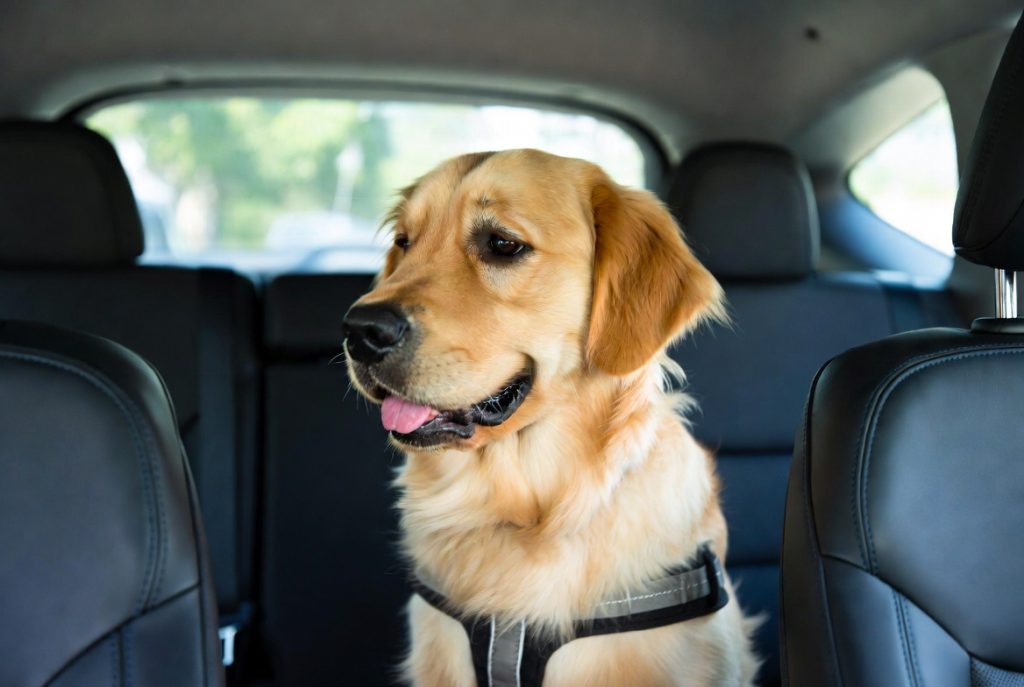
Your auto policy treats the family dog as cargo until something goes wrong, at which point it gets complicated quickly. A handful of state laws and a couple of common endorsements change the picture.
Nobody buys auto insurance thinking about the dog. And yet the dog is present in roughly a third of all family car trips, frequently unrestrained, and capable of producing a 60-pound projectile at 35 mph during a moderate collision. The insurance questions are real, the safety questions are documented, and the gap between what most families assume and what actually happens at claim time is worth closing before you need to use it.
How Auto Policies Treat Pets
Under a standard auto policy, your pet is legally classified as personal property — the same category as luggage or a child’s car seat. That means the liability section of your policy does not cover injuries your pet causes to another person inside the vehicle, and your collision coverage doesn’t pay veterinary bills. If your unrestrained dog causes an accident by jumping on you, the at-fault liability is yours. If the dog is injured in a collision, the payout — if any — is capped at the animal’s market value, not your vet bill.
In practice, insurers rarely pursue pet-related depreciation claims on vehicle damage caused by a dog. But they also rarely volunteer to pay vet bills. The standard policy simply wasn’t written with the animal’s welfare in mind.
States With Pet-Restraint Laws
Four states have enacted laws specifically addressing how pets must be transported in vehicles. New Jersey prohibits transporting an animal in a way that endangers the driver or animal — violations run $250 to $1,000 and can affect your driving record. Hawaii prohibits animals in a driver’s lap. Maine and Rhode Island have passed advisory language, though enforcement is limited. A handful of other states are actively considering legislation.
What this means for your insurance: a pet-related infraction in New Jersey goes on your motor vehicle record. That record feeds your insurance rate at next renewal. An unrestrained dog that directly contributes to an accident can also be cited by an insurer as a contributing factor when determining comparative fault.
The “Pet Injury” Endorsement
Several carriers — most notably through partnerships with third-party pet coverage providers, and directly through some regional insurers — now offer a pet injury endorsement on auto policies. The AAA version covers veterinary expenses up to $1,000 per accident with no deductible if the pet is in the insured vehicle. Some comprehensive coverage policies (not liability) cover pet injury under the personal property damage umbrella, though limits are often $500 or less.
If you have a large or expensive dog and take it in the car regularly, call your carrier and ask directly whether a pet endorsement is available. The annual premium cost is typically $20 to $50 — less than most emergency vet visit copays. It won’t cover routine injury, but it exists for exactly the collision scenario.
Practical Restraint That Survives a 30 MPH Stop
Here’s the crash physics problem: an unrestrained 50-pound dog becomes a 1,500-pound projectile in a 30 mph frontal collision. That’s not a rounding error — it’s the product of G-force multiplication at impact. Standard soft-sided carriers offer minimal protection. Seatbelt clips marketed as “pet safety harnesses” vary enormously in quality.
The Center for Pet Safety (CPS) has conducted independent crash testing on pet restraint products since 2013. As of their most recent test series, only a handful of harnesses have passed a 30 mph frontal crash simulation while maintaining integrity and keeping the dog inside. Sleepypod, Ruffwear, and a few others have CPS-certified products. Most popular harnesses sold at pet retail chains have not been crash-tested at all.
For cats and small dogs, a hard-sided carrier rated for air travel provides better crash protection than most vehicle-specific products, provided it’s secured to the seatbelt or cargo anchor.
What to Do This Week
Look up your specific harness or carrier on the Center for Pet Safety’s certification page. If it’s not listed, treat it as decorative rather than protective. Call your carrier and ask whether a pet injury endorsement is available on your policy — the call takes five minutes. If you’re in New Jersey or Hawaii, confirm your current transport setup complies with state law to keep your driving record clean at renewal.
Ready to put this to work? Pull your current declarations page and compare it against these benchmarks — or run a fresh quote to see where the market has moved since your last renewal.
Last modified: February 28, 2026
About the Author: Alex Morgan