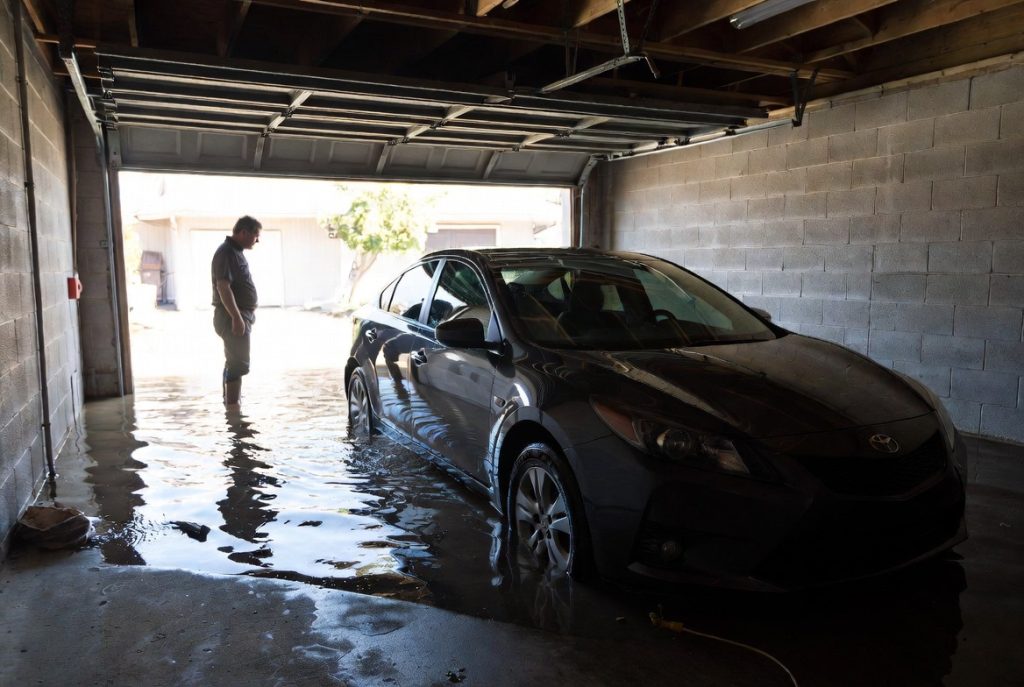
Water in your garage is a strange beast. Your home policy might cover the drywall, your auto policy might cover the car, and somewhere in between is a claim no one wants to handle. The moment water appears in a structure that also houses your vehicles, you’re dealing with two separate insurance contracts, two adjusters, and potentially two deductibles — against a single event. Here’s how it actually splits, and how to document it before anyone makes a phone call you’ll regret.
Where Home Coverage Ends
Standard homeowners policies cover sudden and accidental water damage from internal sources — a burst pipe, an overflowing appliance, or a failed water heater. The key word is sudden. Long-standing seepage, gradual foundation leaks, and rising groundwater are specifically excluded by most HO-3 policies. This is where a lot of garage flood claims get tangled.
If your sump pump backed up and pushed water across the garage floor, you may be covered — but only if you have a sump pump backup endorsement, which is a separate rider that costs $50 to $150 per year and is declined by most homeowners until after their first claim. Standard flooding from storm surge or overland water requires a separate NFIP or private flood policy entirely.
What your homeowners policy will almost certainly cover: the structure of the garage itself — drywall, framing, finished flooring, built-in shelving. What it will not cover: the car sitting in it.
Where Comprehensive Auto Picks Up
This is the piece most people don’t know until they’re standing in six inches of water. Comprehensive coverage on your auto policy covers damage to your vehicle from events outside your control — including flooding. The vehicle doesn’t need to be on a public road. It doesn’t need to be moving. As long as the damage source qualifies (rising water from a storm, for instance), the fact that your car was in your own garage when it happened is irrelevant.
The practical boundary: flood damage to the vehicle is an auto claim, not a home claim. The car’s electronics, engine, interior, and any personal property that is permanently installed are covered under comprehensive. Loose personal property inside the car — a laptop on the back seat, a camera in the trunk — is typically covered under homeowners, not auto, subject to your home policy’s personal property limits and exclusions.
One common misconception: some families assume that because the flooding originated from a plumbing failure (a household system), the auto damage should flow to the homeowners policy. It doesn’t. The source of the water is rarely what determines which policy responds to the vehicle damage.
The Deductible Double-Hit
This is the part nobody enjoys explaining. You may be looking at two separate deductibles on a single bad morning. Your homeowners deductible — often $1,000 to $2,500 — applies to the structural and contents damage covered by that policy. Your auto comprehensive deductible — typically $250 to $1,000 — applies separately to the vehicle.
If your home deductible is $2,000 and your comp deductible is $500, you could owe $2,500 out of pocket before either carrier writes a check, assuming both claims are large enough to clear their respective thresholds. On a moderate garage flooding event — maybe $4,000 in home damage and $3,500 in car damage — you’d net $5,000 in insurance proceeds while absorbing $2,500 yourself.
This is worth knowing before the event, not after. Reviewing your deductible levels annually — especially on homeowners — is one of the few pre-loss decisions that changes your actual outcome in a multi-policy scenario.
How to Document a Multi-Policy Claim in 30 Minutes
Documentation is the single factor most within your control. The adjusters from two different carriers may not communicate with each other, and the burden of proving what happened — and when — falls on you.
Immediate steps (while the water is still present)
- Photograph the water level against fixed reference points — a garage door track, a wheel well, a wall outlet. Timestamps matter.
- Photograph the vehicle before moving it. Document all four sides plus the interior, especially if water entered the cabin.
- Note the weather conditions and time of onset. If it’s storm-related, save a screenshot of the radar or weather service report for your zip code that day.
When you call
- Call your home carrier first if structural damage is present and significant. They may want to send an adjuster before any remediation work begins.
- Call your auto carrier separately and treat it as a completely independent claim. Use your comprehensive coverage, not your collision coverage — the distinction affects your rates differently at renewal.
- Keep a written log of every call: date, time, rep name, claim number, and what was agreed.
What to do this week: Check whether your homeowners policy includes a sump pump backup endorsement. If it doesn’t, call your agent and add one. The annual cost is typically less than a single dinner out, and it closes the most common gap in exactly this scenario.
Ready to put this to work? Pull your current declarations page and compare it against these benchmarks — or run a fresh quote to see where the market has moved since your last renewal.
Last modified: February 3, 2026
About the Author: Alex Morgan