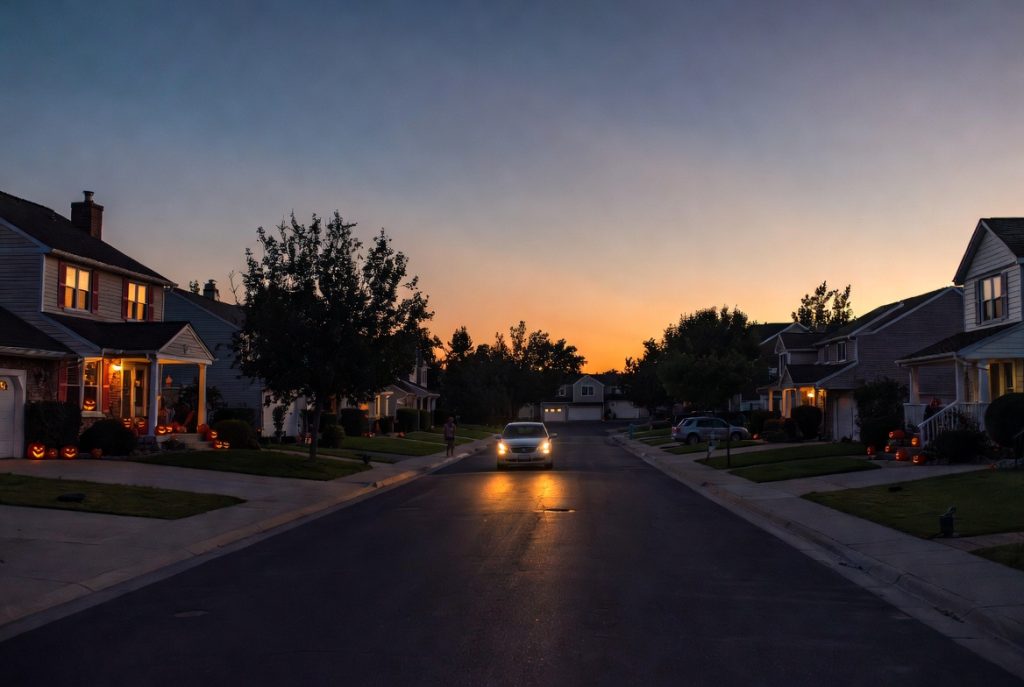
Halloween produces a statistical spike in pedestrian incidents that most drivers don’t think about until they’re already out. The incidents cluster in low-speed, familiar neighborhoods — the kind where people assume nothing can really go wrong because they know every turn and speed bump. Most of the fix is behavioral, but the policy implications are real enough to understand before the night.
The Data, Plainly
NHTSA pedestrian data consistently shows that Halloween evening — specifically the two hours between 5:30 and 9:30 p.m., depending on local trick-or-treat hours — produces a meaningful spike in pedestrian fatalities and injuries compared to the same hours on adjacent Tuesdays and Thursdays. The increase isn’t small: some analyses show pedestrian fatalities on October 31 running two to three times the base rate for comparable fall evenings.
The profile of the incidents is instructive. Most occur in residential neighborhoods, not arterials. Most involve low-to-moderate vehicle speeds. The pedestrian is often a child, often in dark clothing, often moving laterally across a roadway mid-block. The driver is often distracted — not by a phone, but by the environment itself: kids on both curbs, costumed figures in peripheral vision, parents stepping off the curb to wave across the street.
Understanding this profile points directly to what actually changes the outcome.
Three Driver Habits That Move the Needle
Drop below 15 mph in residential trick-or-treat zones. This sounds patronizing until you do the stopping distance math. At 25 mph, a full stop from brake application takes about 60 feet for an average car with a alert driver. At 15 mph, that drops to roughly 25 feet. The child who runs between parked cars to catch a sibling doesn’t give you 60 feet of warning. This is the single most effective change a driver can make on Halloween evening.
Turn off infotainment displays. Navigation, podcasts, the screen your kid in the backseat is watching — all of it competes for peripheral attention. Halloween driving in a dense residential area is fundamentally a visual task, and it’s more cognitively demanding than it looks. Reducing in-cabin visual competition isn’t overcautious; it’s calibrated.
Give parked cars a wider berth than usual. Trick-or-treaters move between cars on both sides of the road without warning. The typical Halloween incident isn’t a rear-end collision — it’s a pedestrian emerging from between two parked vehicles into a lane that appeared clear a second earlier. Driving toward the center of the lane (within traffic rules) buys reaction time.
Three Host Habits That Affect Liability
Porch lights, clearly on or clearly off. The unlit porch is a meaningful signal to trick-or-treaters to skip a house. The dimly lit porch is an ambiguous signal that draws children onto the property. From a premises liability standpoint, a clear signal either way reduces the traffic and the associated slip, trip, or fall exposure on your property.
The driveway problem. If you live in a neighborhood where cars are moving throughout the evening, your driveway is a shared-use zone. Children cutting across driveways, adults reversing without looking — the driveway is where a significant number of Halloween incidents actually occur. If you’re hosting and vehicles are moving in and out, designate someone to spot and signal before any vehicle moves.
Decorations and trip hazards. Low-to-ground decorations, extension cords across walking paths, and fog machine mist that obscures ground-level hazards are common causes of fall claims on Halloween. These fall under your homeowners liability coverage, not auto — but the principle of reducing foreseeable hazards applies equally.
When Your Policy Doesn’t Follow You to a Costume Party
If you’re attending an adult Halloween event and sharing driving duties with another adult, the standard permissive use rules apply: a friend who borrows your car for a legitimate purpose is covered under your policy as a permissive driver, subject to your coverage limits. Your policy covers the car, not the named insured specifically.
The complication arises when the “designated driver” arrangement involves someone who doesn’t own a car and doesn’t carry their own policy. In that case, your policy is primary for any incident in your vehicle. If they have their own non-owner policy, it may be secondary. This isn’t a reason to avoid ride-sharing with friends — it’s a reason to know whose policy is covering what before the keys change hands.
One more note: if you’re driving for a rideshare platform on Halloween evening, your personal auto policy does not cover you during active trips. Your rideshare company’s commercial policy does, but there’s a gap period (app on, no passenger matched) where coverage varies. Check your rideshare platform’s current coverage documentation if this applies to you.
What to Do This Week
- Plan your route home on Halloween evening to use arterials rather than residential streets wherever the time cost is minimal. The 90-second detour isn’t worth debating.
- If you live in a high-traffic trick-or-treat neighborhood, designate a spotter for any vehicle movement in the driveway during peak hours.
- Check your homeowners liability limit — most policies carry $100,000, but $300,000 is widely recommended for households with regular visitor traffic, which Halloween amplifies considerably.
- If you’re going to a Halloween event and another adult is driving your car, confirm that they have a valid license before you hand over the keys. No coverage exception exists for “I didn’t know they were suspended.”
Ready to put this to work? Pull your declarations page and verify your liability limits — or run a fresh quote to make sure your coverage levels are appropriate for your household’s actual exposure.
Last modified: April 3, 2026
About the Author: Alex Morgan