
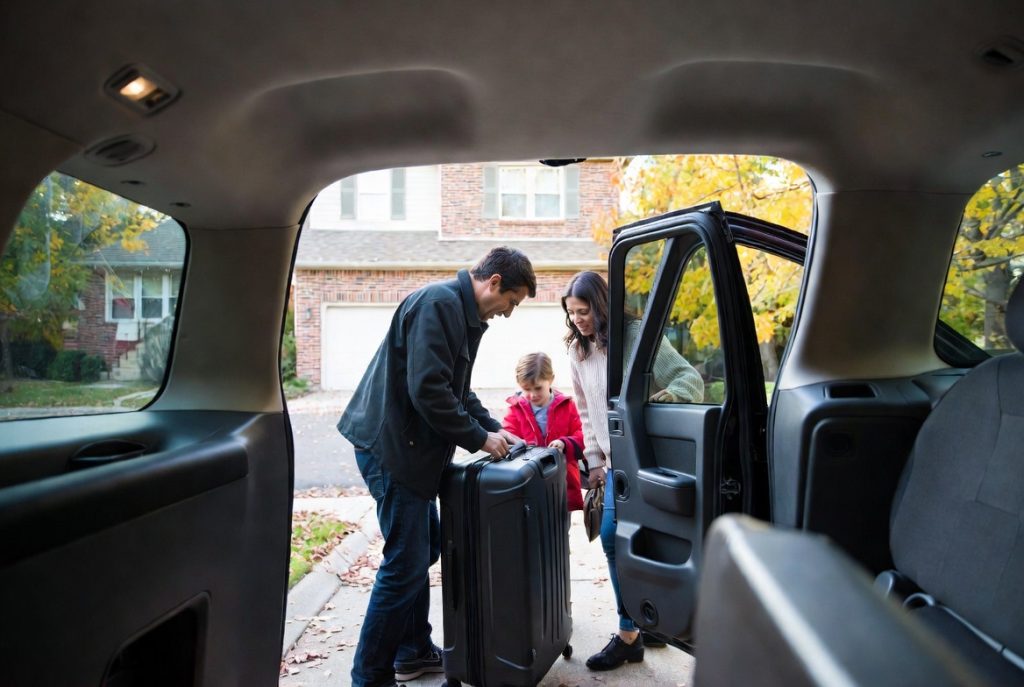
For a family of four, the drive-vs-fly decision usually comes down to time, cost, and how many times you’re willing to hear “are we there yet.” But there’s a third lens — the actual risk exposure and insurance considerations of a 600-mile holiday drive — that rarely makes the spreadsheet. It should, at least briefly, because it changes the math in a few specific situations.
The Standard Cost Comparison
The basic arithmetic is familiar. Flying a family of four on a Thanksgiving week booking typically runs $800–$1,800 round trip, plus airport parking, ground transportation at the destination, and whatever you spend in the terminal. A 600-mile drive uses roughly 20 gallons of fuel each way at 30 mpg — $70–$90 per tank at current prices. Total fuel: $140–$180. Add tolls, meals, and two nights of hotel if you break the trip, and you’re looking at $300–$500 all-in.
Time math: 600 miles at 65 mph is 9.2 hours of driving without stops. With family stops, traffic, and a meal, that’s realistically 11–13 hours. A three-hour flight becomes 5–6 hours door-to-door once you account for airport logistics. For shorter distances — under 400 miles — the time gap narrows considerably; the car often wins on both cost and time.
None of this is surprising. The interesting variables are below the surface.
The Hidden Risk Variables
Holiday-week accident rates are elevated. The Wednesday before Thanksgiving and the Sunday after are consistently among the highest-volume travel days of the year, and traffic volume correlates with accident frequency. More vehicles on the road, more fatigued drivers making long trips, more alcohol-impaired driving on the return, and more weather variability in late November combine to make holiday-week driving statistically riskier than an equivalent-distance trip in September.
This doesn’t mean you shouldn’t drive — it means driving at off-peak times (Tuesday rather than Wednesday, Monday return rather than Sunday) has genuine safety value and, in some states, minor insurance implications for usage-based policy holders who track when they drive.
Wear, tear, and mechanical exposure. A 1,200-mile round-trip adds roughly 2% of annual mileage to a vehicle driven 60,000 miles over its life. That’s not significant in isolation. What matters more: the condition of the vehicle before the trip. A car that’s been running slightly rough or has a warning light you’ve been deferring to winter is a car that’s more likely to strand you in a rural stretch of I-81 in November. A pre-trip inspection — tires, brakes, fluids, battery — costs $20–$50 at most shops and is the most cost-effective insurance purchase you can make before a long holiday drive.
Rental car coverage at the destination. If you fly and rent a car at the destination, your personal auto policy typically extends to that rental. But rental coverage works differently for extended rentals — if you’re renting for five or six days, credit card secondary coverage may cap out. Know your card’s rental limit before you decide how to handle the collision damage waiver at the rental counter.
When Driving Wins, When It Loses
Driving wins when: the distance is under 500 miles; your vehicle is in good mechanical condition; at least two adults can share driving; you’re flexible on departure time and can leave off-peak; and you’re traveling to a rural destination where a rental car would be needed anyway.
Flying wins when: the distance is over 800 miles; only one adult can drive; late-November weather along the route is historically unpredictable; the destination requires significant local driving anyway; or the cost savings from driving are modest enough that the time trade-off doesn’t pencil out for your household’s schedule.
The often-overlooked middle option: Train or bus travel on the Northeast Corridor and some Midwest routes is genuinely competitive on a total-cost, total-time basis for family travel. It avoids both airport overhead and long-distance driving fatigue, and there’s no insurance consideration to manage.
A Weekend Planning Template
The decision framework is straightforward once you make it explicit:
Step 1: Calculate true cost, both ways. Flights plus ground transport vs. fuel plus tolls plus meals plus any hotel stops. Use actual quotes, not estimates.
Step 2: Assess vehicle condition. If the car needs work, add that to the driving cost — or factor it as a reason to fly.
Step 3: Check your auto policy before you go. Confirm roadside assistance is active, note your rental reimbursement daily limit, and verify whether your telematics program logs high-mileage holiday weeks differently.
Step 4: Time the departure strategically. Leaving at 6 a.m. on Wednesday instead of 3 p.m. on Wednesday typically cuts two to three hours from a 10-hour drive. This is a free upgrade.
What to Do This Week
- Pull your auto policy declarations page and locate the roadside assistance section — confirm coverage limits and the towing distance cap before a long trip.
- If you’re renting at the destination, check your credit card’s rental car benefit terms; most cards cap coverage at 15–31 days, but other restrictions apply.
- Schedule a pre-trip tire pressure and fluid check if you’re driving more than 400 miles — many shops offer this at no charge as a courtesy service.
- If you’re on a telematics plan, note when your policy period resets and whether the holiday-week mileage spike will affect your discount calculation.
Ready to put this to work? Pull your declarations page and check your roadside and rental reimbursement coverage before you commit to the route — or run a fresh quote to see whether your current policy is optimized for a household that takes several long trips per year.
Last modified: April 6, 2026
About the Author: Alex Morgan